Adverb (Basic ㊦ 224)
Someone or something is in some state he or it was in some time ago.
Equivalent: Still; (not) yet
1. まだ expresses the idea that someone or something is in the same state that he or it was in some time ago. In affirmative sentences, まだ always corresponds to 'still'. In negative sentences, however, it corresponds to 'yet' when an action has not yet been taken, and 'still' in other situations, as in Example (c) and Key Sentence (B), respectively.
2. The abbreviated sentence seen in B2 of Example (c) is used only when the response to a question is a negative one.
【Related Expression】
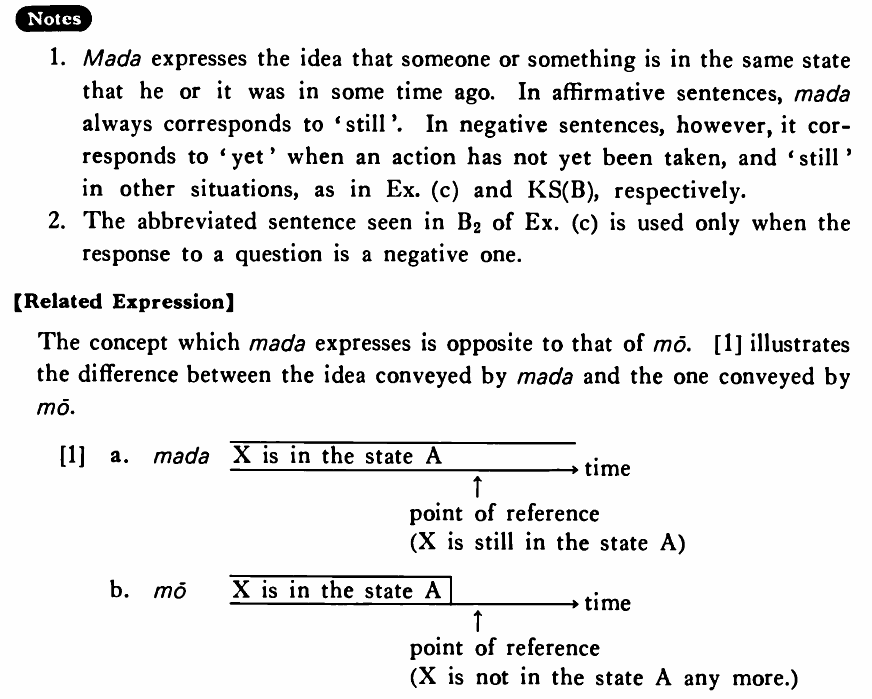
The concept which まだ expresses is opposite to that of もう. [1] illustrates the difference between the idea conveyed by まだ and the one conveyed by もう.
[1]
| a. | まだ | X is in the state A | ~~~~~~~~~~~~~~~~~~~~~~~~~~ | → time |
| ↑ | ||||
| point of reference (X is still in the state A) | ||||
| b. | もう | X is in the State A⎪ | → time | |
| ↑ | ||||
| point of refrence X is not in the state A any more |